Bower Grove School Curriculum
Intent – Implementation – Impact
Bower Grove School is a special school for pupils who have social, emotional, and mental health (SEMH) needs, autism spectrum conditions (ASC), social communication difficulties, and associated learning difficulties.
Curriculum Intent
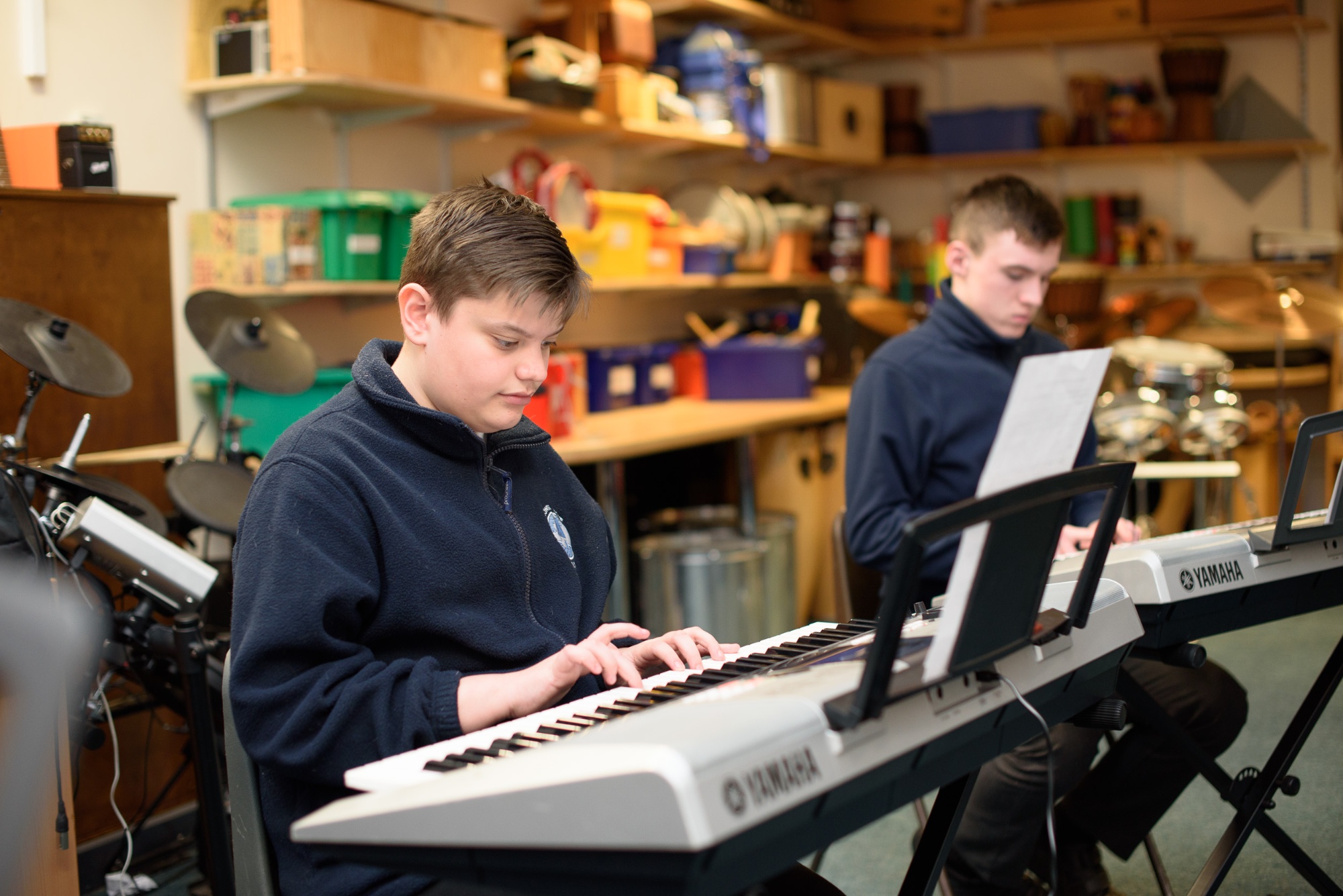
At Bower Grove School, every pupil follows an engaging, meaningful, and individualised curriculum. Lessons are designed to motivate and inspire, with planning centred on each learner’s needs. Research demonstrates that pupils learn best when learning is connected, practical, cross-curricular, and linked to reality. At each stage, our intent is to equip pupils with skills for their next phase of education and life beyond Bower Grove. Clear progression routes and carefully sequenced content allow pupils to build on prior knowledge and skills. We work closely with parents/carers to balance curriculum access with additional experiences that enhance core skills and talents, such as mainstream inclusion, catch-up programs, extra-curricular activities, pastoral or therapeutic support, or alternative offsite learning.
Our curriculum aims to:
-
Ensure pupils have the necessary behaviours for learning to enable them to access the curriculum.
-
Maximise pupil’s engagement by providing motivating and relevant learning opportunities.
-
Support outstanding progress across all areas of learning.
-
Ensure that all pupils have access to a broad, balanced, challenging curriculum based on the National Curriculum.
-
Adopt a personalised approach that allows staff to plan in response to a pupil’s individual needs and interests and consider any barriers to learning.
-
Promote pupils spiritual, moral, social, cultural and physical development in order to become responsible and respectful citizens.
-
Equip our pupils with an understanding of respect for Fundamental British Values.
-
Clearly identify progression pathways for children in Year 9 and above, including access to Further Education, vocational courses and work-related learning.
-
Provide pupils with access to accredited courses at Key Stage 4.
-
Develop independence and life skills through experience and activities such as cooking, travel training, residentials, work experience and the Aspire programme.
-
Prepare pupils for the opportunities, responsibilities and experience of adult life to ensure they are well-placed to make a positive contribution to life beyond school.
-
Monitor and assess pupils progress for the purpose of ensuring outstanding outcomes for all.
-
Engage pupils in understanding how they make improved progress through Assessment for Learning.
Research demonstrates that pupils learn best when learning is connected, practical, cross-curricular and linked to reality. At each stage of our curriculum, our intent is to equip our pupils with skills for the next stage of their education and beyond.
Curriculum Implementation
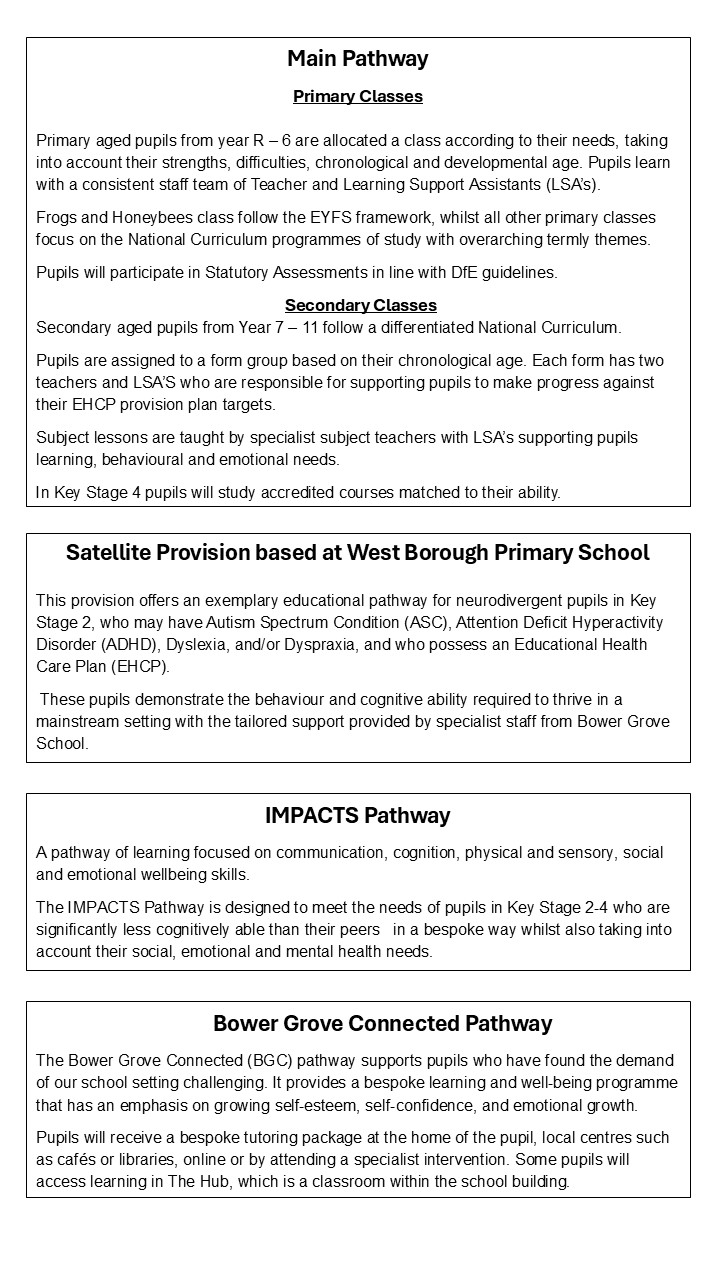
Pupils join Bower Grove School with their own individual learning needs. The school has taken account of recommendations of the Rochford Review (October 2016) in developing 4 different pathway approaches across the school; Main pathway, IMPACTS pathway, Bower Grove Connected and the Satellite Provision at Westborough Primary School. This approach ensures that each pupil can access a curriculum pathway that enables them to make the very best progress that they can. Pupils can move between the curriculum pathways as they develop and move through the school. The emphasis is always to provide an accessible curriculum that enables pupils of all ages to develop behaviours for learning and skills for independence.
Curriculum Impact
At Bower Grove School there are a range of measures used to evaluate the impact of the curriculum across all our learning pathways.
These include:
-
Progress measures using formative and summative assessment. These are recorded formally using Bower Grove Assessment frameworks on Arbor and discussed with Senior Leaders at pupil progress meetings.
-
Monitoring of pupil well-being and engagement through staff and pupil self-assessment.
-
Deep Dives triangulating curriculum intent, implementation and impact.
-
Reviewing Sleuth behaviour data.
-
Monitoring of EHCP provision plan targets across all four areas of need.
-
Reviewing individual pupil support plans to assess the impact of strategies and interventions.
-
Reviewing attendance data.
-
Pupil surveys.
-
Parent surveys.
-
Observation of pupil engagement and learning during formal and informal lesson observations and learning walks.
-
Transition arrangements for Year 6 pupils attending ASC Satellite at West Borough Primary School.
-
Destination data and follow up calls to pupils, parents/carers to ensure transition to college, apprenticeship or employment has been successful.
-
Feedback from other agencies such as social services, Early Help, College, Employers.
-
Reviewing the impact of Safeguarding referrals, support plans and parental engagement.
School governors monitor the effectiveness of our school curriculum. The Governors Pupil Development Committee are responsible for curriculum monitoring and take responsibility for different subjects and areas of the curriculum holding subject leaders and school leadership team to account.
How We Measure Impact
These include:
-
Progress measures using formative and summative assessment. These are recorded formally using Arbor.
-
Senior Leaders/Curriculum leaders work scrutiny
-
Monitoring of pupil well-being and engagement using the Leuven Scale
-
Monitoring the impact of Social, Emotional and Mental Health Interventions
-
Reviewing Sleuth reports of behaviour data
-
Monitoring of EHCP provision plan targets and trackers
-
Reviewing individual pupil safety plans to assess the impact of strategies and interventions
-
Reviewing pupil attendance data
-
Pupil surveys (for pupil voice)
-
Parent surveys
-
Parental feedback at EHCP reviews – completion of Section A form
-
Observation of pupil engagement during regular drop-ins, lesson observations and learning walks
-
Assessing the impact of transitions on pupil well-being at the start of the new academic year or following a change in class.
-
Destination data and follow-up calls to pupils, parents and carers to ensure post-16 transition to college, apprenticeship or employment has been successful.
-
Transition arrangements for year 6 pupils attending the Satellite at West Borough Primary School.
-
Feedback from other agencies such as social services, Early Help, local colleges and employers.
-
Reviewing the impact of safeguarding referrals and parental support and engagement.

Details of Primary Phase, Secondary Phase and Educational Pathways
EYFS/Primary Phase
From the Early Years Foundation Stage through to Year 6, the curriculum is child-centred and tailored to provide our pupils with meaningful experiences through a thematic and sequential approach in a safe and positive environment. This allows pupils to develop academically and socially through irresistible learning opportunities, which build on their prior skills and knowledge. It encompasses the development of communication, interpersonal and problem-solving skills whilst building resilience, independence and enhancing their wellbeing. Pupils in the Primary school will continue their Bower Grove journey into the next phase of their learning with a sense of pride and a zest for lifelong learning.
Satellite Provision at West Borough Primary School
This is a provision for up to twelve Key Stage 2 pupils, years 3–6 with a neurodiversity diagnosis. These pupils have demonstrated appropriate behaviours for learning and can access a mainstream curriculum with specialist support and intervention. These pupils will transfer to a range of settings, including mainstream secondary schools and specialist resource provisions.
Secondary Phase
From Year 7 to Year 11, the curriculum is broad, balanced and relevant; it allows pupils time to explore, deepen their understanding and embed skills for life. There is an emphasis on connectivity between different subjects so that the pupils develop their understanding holistically and make the connection between what they are learning in class and the wider world.
IMPACTS Pathway
This pathway runs throughout Key Stage 2 to Key Stage 4. In Key Stage 2, it is called Squirrels class, in Key Stage 3 Badgers and in Key Stage 4, it is called Oaks class. The aim is to provide pupils who are significantly less cognitively able than their peers with a bespoke curriculum that prepares these pupils for adulthood.
There is a clear focus on developing knowledge, skills and understanding so that these pupils can live a purposeful, meaningful and fulfilled life and are able to contribute to and become an active member of their community.
Enrichment & BG Connected Pathway
The Enrichment Pathway & BGC Pathway is designed to aid pupils who struggle to learn in their normal class environment and it is designed to be flexible in order to cater for a variety of needs.
The Enrichment Pathway allows a small group of pupils with social communication difficulties or those whose anxiety levels are particularly high, to feel secure. This is an integral part of the Enrichment Pathway.
Provision of breakfast, breaktime activities and a secure space to eat lunch allows these pupils to develop socially.
The Educational Health Care Plan (EHCP) targets and Boxall Profiling provide a focus for their support. A core curriculum focus is to develop and improve the social, emotional and mental health of pupils attending the Enrichment Pathway.
The BGC pathway has been implemented to support pupils who have found the demands of our main pathway setting challenging.
BGC aims to create a learning offer that recognises individual differences and provides a supportive atmosphere that encourages personal, social and emotional growth alongside learning.
It provides a bespoke learning and wellbeing programme that focusses on engaging pupils with their learning.
Details of Curriculum Implementation
Main Pathway
Our core curriculum pupils who are ready for formal subject-led learning will follow planning driven by the National Curriculum and accreditation specifications. Each pupil in the school has an individual EHCP provision plan with outcomes and targets which are addressed and embedded into teacher planning.
Curriculum Implementation in the Primary Phase
The curriculum models in the primary phase are main (core offer), IMPACTS and the ASC Satellite provision.
Reception and Year 1 pupils in Frogs class follow the Early Years Foundation Stage areas of learning.
Subject-led learning at Bower Grove from Year 2 to Year 6 focusses on the National Curriculum programmes of study with overarching termly themes. Within each theme there is a range of subthemes which enable the teacher to select topics appropriate to the pupils in their class, with the pupils also having input into their learning pathway.
The National Curriculum programmes of study are covered in English, Maths, Science and PSHE, with aspects of Humanities, and Art and Design Technology being taught experientially through other areas of learning (such as non-fiction texts). Religious Education is delivered through World Beliefs. The study of Modern Foreign Languages focusses on French. However, there is a holistic approach to discovering the language, culture and heritage of other countries during an annual focus day.
Early Years Foundation Stage and Year 1
Pupils in Frogs Class follow the EYFS areas of learning. The timetable is structured around planned play and teacher-directed sessions and the division of time is approximately 90/30 for this. The timetable addresses the prime and specific areas of learning through developing the characteristics of effective learning. There is a weekly Explorer Club trip to encourage our younger pupils to observe the local area and take an interest in the natural world, as well as developing their physical, social and behavioural skills. This time is also used to discreetly consolidate learning in areas such as maths, science and topic.
Year 2 and Key Stage 2 Curriculum Implementation
The majority of pupils from Year 2 to Year 6 follow a subject-led learning approach. There is one class which follows the IMPACTS model. That is Squirrels class. For pupils following the subject-led learning approach, the following areas of learning covered are:
Core |
Experiential |
|
|
|
Nurture-focused activities, including breakfast, take place at the start of every day. PSHE and sensory processing activities are embedded throughout the day to support the development of pupil behaviours for learning. RE is delivered as World Beliefs, enabling a more immersive approach to learning. The experience of aspects of humanities and the arts will be through topic links such as non-fiction texts or enrichment visits. Some classes may take a more subject-led approach if it is right for the pupils in the class. Pupils in IMPACTS class follow the IMPACTS curriculum. |
|
The Sounds Write phonic scheme is used throughout the primary phase to support pupils’ progress in reading and spelling.
Satellite Provision at West Borough Primary School
The Satellite Provision can accept up to three pupils in year groups 3-6. The pupils are based in the two classroom Satellite Provision, where their pastoral and social communication needs are well-supported. Pupils are integrated into mainstream lessons supported by the Satellite staff team. Access and exposure to the mainstream curriculum increases over time, and it is personalised to the abilities of each child. Although on roll at Bower Grove School, these pupils wear the West Borough Primary School uniform and follow the established systems of this mainstream school.
Curriculum Implementation in the Secondary Phase
The secondary curriculum is organised on a subject-based model with pupils moving to specialist classrooms and teachers. Interventions are implemented with identified groups and individual pupils. Setting for lessons, according to demonstrated ability, occurs in English and Mathematics. This enables pupils identified as more able to be extended in their lessons, whilst allowing pupils who need enrichment activities to be supported through greater differentiation. Accredited courses are followed in English, Maths, Science, Computing, Physical Education, Design and Technology, and Cooking.
Work Experience
The Work Experience programmes form an important and integral part of the Key Stage 4 curriculum. Careful planning takes place to ensure that each pupil accesses a suitable placement that progressively extends their abilities and independence. Preparation for work experience starts at the beginning of year 10. Pupils undertake a one-week work placement in year 10 and another in year 11.
Travel Training
Learning to travel independently and extending general independence skills in the wider community is a crucial element of the Key Stage 4 programme. Many pupils achieve independent travel status and are able to use public transport by the end of Key Stage 4. However, for some pupils, travel training is an ongoing intervention and continues to form an important feature of their post-16 individual action plan.
Accreditation
|
Subject |
Entry Level Certificate |
|
Functional Skills |
|
GCSE |
|
English |
Step up Award |
|
|
|
√ |
|
Mathematics |
√ |
|
|
|
√ |
|
Science |
√ |
|
|
|
√ |
|
ICT Computing |
√ |
|
√ |
|
|
|
Design Technology |
|
|
|
|
√ |
|
PE |
√ |
|
|
|
|
|
Arts Award (Music or Art) |
Arts Award Bronze Year 10 Arts Award Silver Year 11 |
||||
|
Food Hygiene Certificate |
|||||
IMPACTS (Individual, Meaningful, Profile, Assessment, Curriculum, Target Setting) Pathway
These pupils are provided with a purposeful, fun and engaging learning environment which encourages them to develop their independence and collaborative skills. Learning is focused on communication, cognition, technology, physical skills and personal, social, and emotional well-being. Learning is creative and experiential, with pupils working towards differentiated outcomes appropriate to their individual needs.
Enrichment Pathway
The Enrichment Pathway provides four waves of support with a different focus and approach:
Wave 1
A pupil’s individual timetable includes some time spent learning in their home environment. One-to-one tuition is provided at least one session per week and this is planned and delivered by the Enrichment Team staff, in conjunction with a Pastoral Support Programme. Staff from the Enrichment Team will also plan for and assess suitable activities and learning tasks for individual pupils.
Academic reports will be produced annually by the Enrichment Team staff, although there will be no formal academic data completed on Pupil Asset; the school’s pupil progress database. Through building positive pupil-staff relationships, the aim is to move the pupil to Wave 2.
Wave 2
A pupil’s individual timetable at this stage is exclusively planned and implemented by the Enrichment Team staff. In this instance, the pupil is affiliated to the Enrichment Pathway which includes their form and registration group. Home learning might be part of these pupil’s individual timetable and is dependent on a variety of factors.
Academic reports will be produced annually by the Enrichment Team staff. When a high level of engagement in the Enrichment Pathway is demonstrated by the pupil with an increased ability to follow school systems, which may also correspond with improvements to the pupil’s social, emotional and mental health, they may progress to Wave 3.
Wave 3
A pupil’s individual timetable is supplemented by the Enrichment Pathway provision. In this instance, a pupil is attached to a form group and participates in the majority of their curriculum lessons. The Enrichment Pathway provision will provide timetabled sessions for the pupil to work with staff on their individual social, emotional and mental health targets. Home learning might be part of an individual pupil’s timetable and is dependent on a variety of factors.
Academic reports will be produced annually with collaboration from the subject teachers and Enrichment Team staff.
With the necessary support for an individual pupil to access the majority of the main school curriculum, whilst meeting their specific social, emotional and mental health needs, there is potential for these pupils to progress to Wave 4.
Wave 4
An individual pupil’s timetable is supplemented by the Enrichment Pathway provision. In this instance, a pupil is attached to a form group and participates in the majority of their curriculum lessons. Staff working in the Enrichment Pathway provision will provide support in certain subjects to assist with the pupil’s learning and reintegration to the main school setting.
Academic reports will be produced annually by subject teachers, but the Enrichment Pathway staff team will contribute as appropriate. With increased resilience and independence, a pupil may demonstrate that they are able to access all curriculum subject areas.
All activities that are planned and implemented by the Enrichment Pathway staff will aim to support pupil progress towards their individual EHCP and Boxall targets. Offsite visits will be planned in collaboration with the Educational Visits Coordinator and the visit aims will include increasing the daily physical activity of pupils to providing them with an experience of new and interesting environments. These pupils will be taught how to find and make a variety of recipes that can be prepared in the Enrichment Pathway kitchen area. These pupils can also develop their literacy and numeracy skills when buying the ingredients required. The pupil’s knowledge of health and safety, and their culinary skills can be developed when preparing and producing a range of meals at school.
Pupils also have access to the school allotment and the outside learning areas. A love of the outdoors can be instilled by promoting the enjoyment of caring for plants and wildlife. The skills needed to grow plants and manage a garden or allotment space can also be taught. Pupils will participate in a variety of collaborative activities that will target their social development. For example, a variety of board games are available to be played in small groups, teaching pupils the skills of turn-taking, managing emotions, communicating with adults and peers and also experiencing winning and losing.
Pupils will also participate in different forms of physical activity during their school day. This aims to promote their positive mental and physical well-being, whilst encouraging a life-long enjoyment of physical activity. Examples of daily physical activities include walking around the local area, completing a daily mile challenge, participating in a variety of sports for enjoyment and visits to local parks. The local amenities are varied and of high quality. Bower Grove School possesses excellent Physical Education facilities and a highly qualified department.
The Enrichment Pathway staff, working in collaboration with the pupils, set daily and weekly targets for each pupil. Reward activities are offered frequently to support pupils to make progress and display positive behaviour. Pupils also join in with the whole school rewards afternoon activities which take place each term, (six times each academic year).
Curriculum Impact
At Bower Grove School there are a range of measures used to evaluate the impact of the curriculum across all our learning pathways.
How We Measure Impact
These include:
- Progress measures using formative and summative assessment. These are recorded formally using Pupil Asset,
- Senior Leaders/Curriculum leaders work scrutiny
- Monitoring of pupil well-being and engagement using the Leuven Scale
- Monitoring the impact of Social, Emotional and Mental Health Interventions through Boxall Profile assessments
- Reviewing Sleuth reports of behaviour data
- Monitoring of EHCP provision plan targets
- Reviewing individual pupil behaviour plans to assess the impact of strategies and interventions
- Reviewing pupil attendance data
- Pupil surveys (for pupil voice)
- Parent surveys
- Parental feedback at EHCP reviews – completion of Section A form
- Observation of pupil engagement during regular drop-ins, lesson observations and learning walks
- Assessing the impact of transitions on pupil well-being at the start of the new academic year or following a change in class.
- Destination data and follow-up calls to pupils, parents and carers to ensure post-16 transition to college, apprenticeship or employment has been successful.
- Transition arrangements for year 6 pupils attending ASC Satellite at West Borough Primary School.
- Feedback from other agencies such as social services, Early Help, local colleges and employers.
- Reviewing the impact of safeguarding referrals and parental support and engagement.
School governors monitor the effectiveness of our school curriculum. The school Governor's learning and development team are responsible for curriculum monitoring. They take responsibility for different subjects and areas of the curriculum, holding the subject leaders and school leadership team to account.